
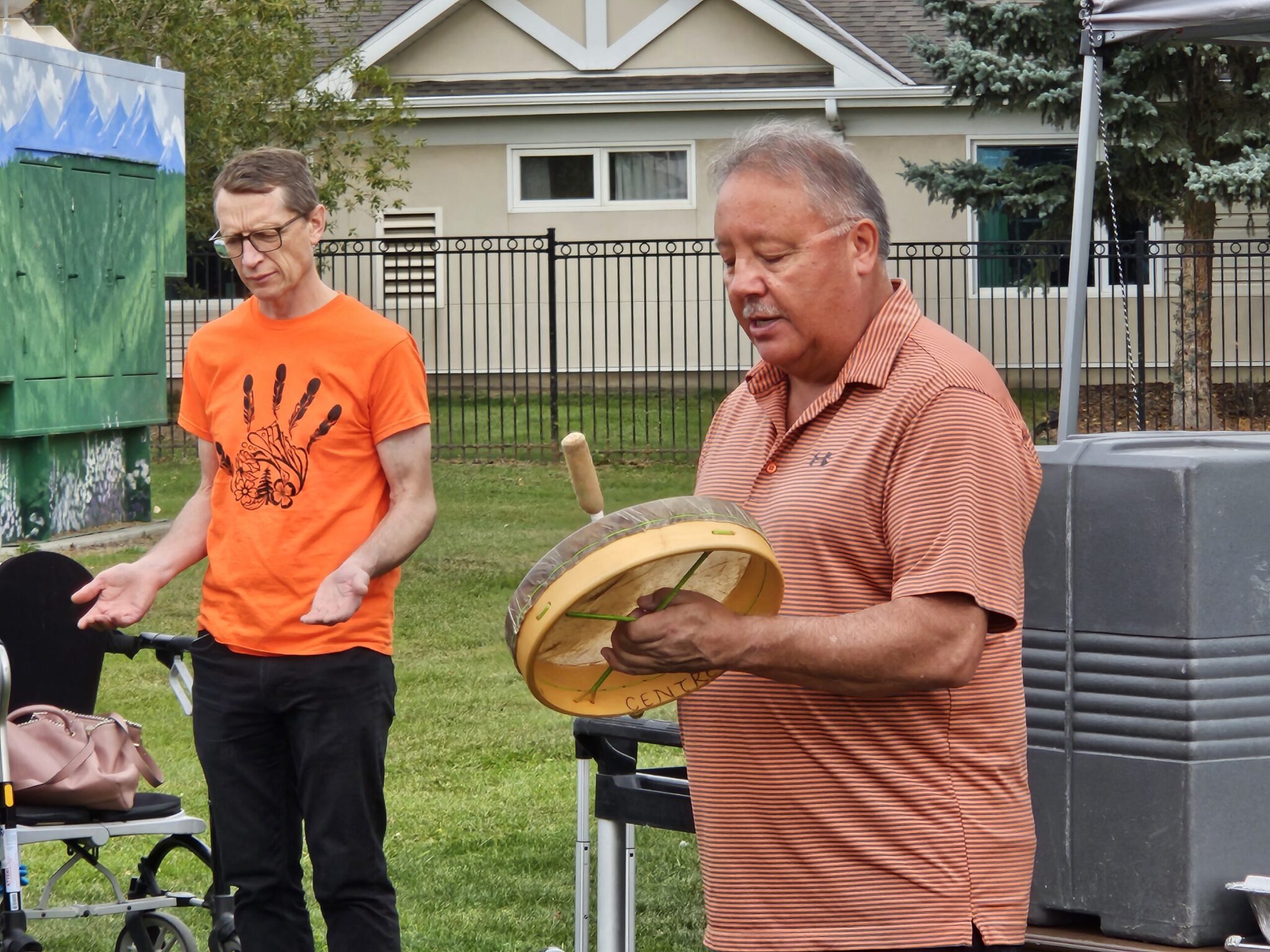
Grace Village holds special smudging ceremony ahead of Truth and Reconciliation Day
The Salvation Army’s Grace Village in Edmonton held a special smudging ceremony on Tuesday ahead of Truth and Reconciliation Day to acknowledge and honour the generations of past and present indigenous peoples affected by Canada’s residential school system.
The ceremony was organized by Grace Village’s Chaplain John Luth and led by Elder Harold Roscher, who performed the smudging and sang a song from the Mi’kmaq First Nations tribe in Atlantic Canada. The event included a chef who cooked up some bannock – a traditional type of bread that became a staple for many indigenous families.
“The Salvation Army has committed to the journey of truth and reconciliation, and so this is an event that is just a really natural one for us to promote and support,” Chaplain John said. “Wehave so many indigenous participants across our programs, so it’s also really important and meaningful to honour them as well.”
Residents of Grace Village and Grace Manor gathered outside in a semi-circle and listened to Elder Harold share the importance of learning and talking about Canada’s not-so-distant history and the positivity we can create when people from different backgrounds come together with respect and empathy.

“It’s all about recognizing humanity,” Elder Harold said after the ceremony. “Indigenous kids weren’t recognized for the gift that they were simply because of the colour of their skin, and so that’s why Truth and Reconciliation has become important.”
“The journey is more fun when we have everybody along with us,” he added. “And certainly, from my perspective of trying to disseminate information, I need allies. So, the more people that can tell the story, the better.”
Sage was used for the ceremony, which is also known as the women’s smudge. The smoke symbolically washes a person from head to toe.
Before the smudging ceremony began, Elder Harold asked all the participants to remove items like glasses, hats, and watches. He explained that people come into the world as naked babies full of humility, and when people go through the smudging process, they should approach it with the same humility.
“While we’re doing this, we are asking Creator, or whomever you subscribe to, to help you on your journey today to create in you that moment of a clean heart,” Elder Harold said before the smudging. “Having a clean heart usually translates to the words coming out of my mouth being more meaningful, more loving, and more kind. So that’s one of the reasons we smudge.”
An element of Truth and Reconciliation Day is wearing an orange shirt to raise awareness and show solidarity. The act stems from when six-year-old Phyllis Webstand enthusiastically wore her new orange shirt on her first day at a Williams Lake, BC, residential school in 1973. When she arrived, the school cut her hair, stripped her of her clothes, and she never saw her orange shirt again.
“The colour orange has always reminded me of that and how my feelings didn’t matter, how no one cared, and how I felt like I was worth nothing. All of us little children were crying, and no one cared,” she wrote years later.
The residential schools aimed to indoctrinate indigenous children “into Euro-Canadian and Christian ways of living and assimilating them into mainstream white Canadian society.”

Cindy, who is currently staying at The Salvation Army’s Cornerstone program for sober living, participated in Tuesday’s smudging ceremony. Her grandmother attended a residential school, and she explained that her traumatic experience affected how her family would go on to approach their own culture.
“My mom never spoke Cree to us. She knew Cree fluently, and she spoke it with my grandparents, but they didn’t speak it to their children…she didn’t teach us any of the leatherworking and beading. She didn’t teach us any of that,” Cindy said. “She was trying to help us to be able to integrate into the white society.”
Cindy believes Truth and Reconciliation Day is leading to a greater awareness of the residential schools’ impact on indigenous communities that hasn’t been as accepted in the past. Acknowledging what happened is not only giving non-indigenous Canadians more knowledge, but indigenous people who are affected by the residential school system are also beginning to understand their own trauma better.
“There’s a lot of people that are still carrying all that trauma because it just gets passed from one generation to the next. A lot of people are healing because they know now where that is coming from. But they didn’t understand it back then,” she said.
“(My grandmother) didn’t talk much about anything, and my mom didn’t either. They just held all that stuff inside as a way to cope.”

Elder Harold was present when the land that the newly built Grace Village sits on was blessed. He believes simple acts like a land blessing, holding a smudging ceremony outside, and serving bannock display a willingness to look for opportunities to show progression and an awareness of social issues that were rarer only a few years ago.
“What I like about the Salvation Army thinking about these moments is that they’re thinking,” Elder Harold said. “Even thinking about having this (event) outside – Indigenous people like being on the land…they could have served hot dogs, and people wouldn’t have complained one little bit, but it’s a nice touch to have fried bannock. It makes you feel like your culture is being honoured and recognized.”
Elder Harold believes wearing an orange shirt is an excellent way to acknowledge Truth and Reconciliation Day because it is not only a conversation starter, but it also makes the person wearing the shirt responsible for educating themselves about Canada’s residential schools.
“I like the shirt because it’s there. It makes you want to ask that question: ‘Why are you wearing orange today?’” Elder Harold said.
The Salvation Army will continue to recognize Truth and Reconciliation Day each year and encourages its staff to reflect as we recognize the historic and current impact that the residential school system had on Indigenous communities across Canada.
